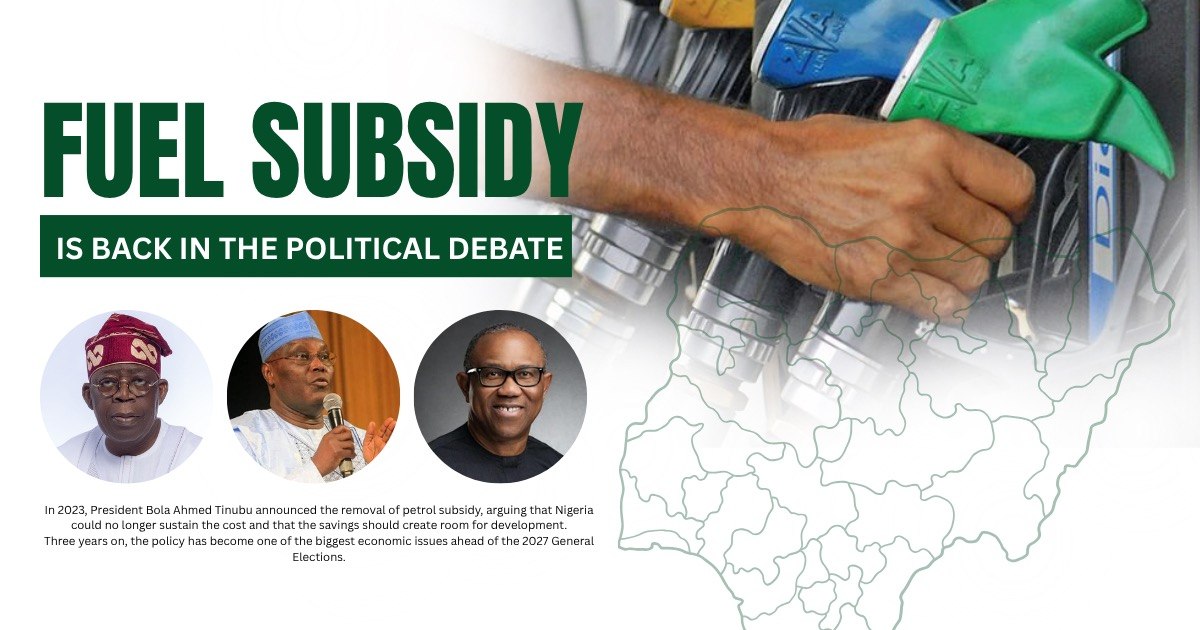

For millions of Nigerians, the fuel subsidy debate is not really about economics textbooks, government budgets or political speeches. It is about how much it costs to get to work every morning, to take a child to school, to move food from the farm to the market, to run a generator when the electricity fails, or to keep a small business open for another day.
That is why, as Nigeria enters the 2027 presidential election season, the question of whether petrol subsidies should return has quickly become one of the most politically sensitive economic issues in the country.
The debate has also acquired a clear political dimension. President Bola Ahmed Tinubu, the presidential candidate of the ruling All Progressives Congress (APC), is seeking a second term after making subsidy removal one of the defining decisions of his administration. Former Vice-President Atiku Abubakar, now the presidential candidate of the African Democratic Congress (ADC), is campaigning on a proposal to restore petrol subsidies under a redesigned system. Former Anambra State governor Peter Obi, now the presidential candidate of the Nigeria Democratic Congress (NDC), has taken a different position, arguing that the removal of the subsidy was necessary but that the resources freed by the reform must be better managed and translated into public benefit.
The disagreement is therefore not simply about the price Nigerians pay at filling stations. It is about how government raises and spends public money, who bears the cost of economic reforms, how citizens are protected from sudden shocks and whether the benefits of difficult policy decisions eventually reach ordinary households.
The debate goes back to one of the most dramatic moments of the Tinubu presidency.
On 29 May 2023, shortly after being sworn in as President, Tinubu declared in his inaugural address that “fuel subsidy is gone.” He argued that the subsidy had become too expensive, increasingly benefited wealthier Nigerians and consumed resources that could be better invested in infrastructure, education, healthcare and jobs. Tinubu was sworn in at about 10:36 a.m.; within hours of his subsidy announcement, queues began returning to filling stations and petrol prices started rising sharply in several parts of the country.
The speed of the announcement became part of the controversy. Tinubu's administration later clarified that the statement reflected the incoming government's understanding that the subsidy arrangement was already scheduled to end, with the 2023 budget providing for subsidy payments only until June. Nevertheless, the immediate market reaction was significant. Within days, petrol prices in many locations had risen from around ₦195 per litre to as much as ₦600, while transport fares and the prices of goods and services also increased.
For the government, the reform was intended to stop what it considered an unsustainable drain on public finances. For many households, however, the first experience of the reform was much more immediate: a more expensive journey to work, higher transport fares, increased business costs and a sharper squeeze on already limited household incomes. This is what makes the subsidy question so difficult.
There was a serious economic argument for ending the old system. There is also a serious social argument about whether the way it was removed and what followed adequately protected Nigerians from its consequences.
The World Bank has argued that Nigeria's former petrol subsidy was costly and poorly targeted. Between 2019 and 2022, it estimates that the country spent more than ₦8.6 trillion on petrol subsidies, while higher-income households captured a larger share of the benefit because they generally consumed more petrol. The World Bank also identified smuggling and other leakages as problems associated with the system.
From this perspective, simply returning to the old subsidy arrangement without changing how it is designed, funded and monitored would risk recreating many of the problems that made reform necessary. But that is only one side of the story.
The same reform that was expected to improve Nigeria's fiscal position also imposed a major shock on households and businesses. Reuters reported that the removal of the subsidy, alongside other reforms including the naira's devaluation, contributed to a severe cost-of-living crisis, with transport and energy costs rising significantly.
This tension is now at the heart of the 2027 debate.
Should Nigeria return to some form of petrol subsidy to protect citizens from high energy costs? Should the country maintain its current direction and allow petrol prices to reflect market conditions? Or is there a third option, one that protects vulnerable Nigerians without recreating an expensive and poorly targeted subsidy system?
These are not questions that should be answered simply by campaign promises.
They require Nigerians to look at the evidence: what the old subsidy cost, what its removal has achieved, what it has cost households, where the resulting fiscal space has gone, who has benefited, who has been left behind and what each presidential candidate is actually proposing.
As the 2027 election approaches, the fuel subsidy debate offers an important opportunity for voters to demand something more substantial from political parties: clear numbers, realistic plans, transparent funding, measurable targets and policies that can be judged by their impact on the lives of citizens. The question, ultimately, is not simply whether petrol should be cheaper. It is whether Nigeria can build an economic system in which citizens can afford to live, businesses can remain productive, and government can manage public resources responsibly, without repeatedly shifting the cost of policy failures onto the people.
The cost of reform was immediate
The difficulty with the subsidy debate is that the fiscal argument and the human cost of reform are both real. Ending the subsidy addressed a significant pressure on public finances, but it also produced an immediate shock for households and businesses.
Following President Tinubu’s announcement on 29 May 2023, petrol prices rose sharply across the country. The increase did not stop at the filling station. Transport fares rose, businesses faced higher operating costs, and the cost of moving food and other goods increased. For households already struggling with limited incomes, the effect was felt in everyday expenses.
According to the World Bank, average retail gasoline prices increased by 163 per cent in 2023, while inflation and the wider cost-of-living pressures weakened household purchasing power.
The impact is particularly significant in Nigeria because petrol is deeply connected to economic activity. Most goods and people move by road, while millions of households and businesses rely on petrol or diesel generators when public electricity is unavailable. A rise in fuel prices therefore affects far more than motorists. It feeds into the cost of transportation, food, production, trading and basic services.
This was why the World Bank argued that subsidy reform needed to be accompanied by stronger and better-targeted social protection. Its projections suggested that removing the subsidy could create about ₦2 trillion in fiscal savings in 2023 and more than ₦11 trillion by the end of 2025.
But these figures should not be understood simply as money sitting in government accounts waiting to be distributed. The real question is what fiscal space the reform created, how government used it and whether citizens have seen meaningful benefits as a result.
This is where the debate moves beyond whether subsidy removal was necessary. Nigerians are entitled to ask whether the savings and wider fiscal benefits of the reform are being translated into better public services, stronger social protection, infrastructure, reliable electricity, improved transportation and ultimately a better quality of life.
The success of the reform, therefore, cannot be measured only by how much government no longer spends on petrol subsidies. It should also be measured by what Nigerians receive in return.
Nigerians are telling politicians what the reform feels like
The impact of the reform is not captured by government revenue figures alone. Public opinion offers another important measure: how Nigerians themselves believe the policy has affected their lives.
An Afrobarometer survey conducted in Nigeria in 2024 and published in 2025 found that 85 per cent of respondents disapproved of the removal of the fuel subsidy, while only 12 per cent approved. Nearly six in ten respondents, 58 per cent, said the government should reinstate the subsidy, even if that meant reducing spending in other areas such as health and education.
The findings do not, on their own, prove that restoring the subsidy would be the better economic choice. They do, however, show the depth of public dissatisfaction with the way the reform has been experienced and the difficulty government has had in convincing many Nigerians that the immediate costs are being matched by sufficient benefits.
The dissatisfaction also extends beyond fuel prices. According to the same Afrobarometer survey, 93 per cent of respondents said the country was heading in the wrong direction, while 88 per cent described Nigeria's economic condition as fairly bad or very bad.
For politicians and policymakers, these figures should mean more than another set of election statistics. They point to a deeper problem of public trust.
Economic reforms are often difficult, and citizens may be willing to accept short-term sacrifice when they understand why a policy is necessary, believe the burden is being shared fairly and can see a credible path to improvement. The challenge arises when the costs are immediate and visible, while the promised benefits remain uncertain or difficult to see.
That is where the 2027 debate should become more serious. Nigerians should not have to choose between affordable fuel and responsible public finances. Candidates should be required to explain how their policies would protect vulnerable households, maintain fiscal sustainability and ensure that the benefits of economic reform are visible in the everyday lives of citizens.
Tinubu's case: fiscal sustainability and public value
President Tinubu's defence of subsidy removal rests on a straightforward argument: Nigeria could no longer afford the old system. His administration maintains that ending the subsidy increased government revenues, strengthened fiscal capacity and created resources for infrastructure, social programmes and other public priorities.
The government says the reform generated ₦15.8 trillion in additional resources for the Federation between June 2023 and December 2025. It estimates that states received about ₦9.17 trillion and local governments ₦6.66 trillion in additional allocations during this period. The administration has pointed to infrastructure, salaries, pensions, social programmes and other interventions as evidence of how these resources are being used.
The World Bank broadly supports the direction of the reform, describing subsidy removal as important for restoring Nigeria's fiscal position, while stressing the need for stronger social protection and more transparent use of public resources.
There is therefore a serious economic argument for the reform. But fiscal improvement is not the same as improved welfare. Larger government revenues and allocations only matter to citizens if they translate into better roads, schools, healthcare, electricity, transport, social protection and other measurable improvements.
This is the central accountability question for 2027: if Nigerians were asked to bear the immediate cost of subsidy removal, what measurable value have they received in return?
Atiku has reopened the argument
Atiku Abubakar has reopened the subsidy debate by challenging the idea that its removal must remain permanent. The African Democratic Congress (ADC) presidential candidate has proposed restoring a redesigned subsidy system focused on locally refined petrol, preferential crude supply to qualifying domestic refineries, spending limits, monitoring of subsidised crude and penalties for diversion. He argues that subsidy should follow domestic production rather than continue to support imported fuel.
The proposal deserves to be examined on its merits, but it also raises important questions. Atiku supported subsidy removal during the 2023 presidential campaign, making his current position a significant change. Voters are therefore entitled to ask what has changed in his economic assessment. Changing a policy position is not necessarily wrong; evidence and circumstances can change. But a changed position should come with a clear explanation.
More importantly, any new subsidy system would have to confront the weaknesses of the old one. How much would it cost? Who would benefit? How would diversion and smuggling be prevented? How would government verify domestic production and crude utilisation? And what safeguards would allow citizens to track the money involved?
For Atiku, the credibility of the proposal will therefore depend on more than the promise of cheaper petrol. He must demonstrate that his proposed system can deliver relief to citizens without recreating the fiscal waste, leakage and governance failures associated with the old regime.
Obi shifts the debate to what government does with the money
Peter Obi takes a different position. He has argued that removing the subsidy was necessary, but that poor management of the resources freed by the reform should not be used as a reason to restore it. His focus is therefore less on bringing back cheaper petrol and more on what government does with the additional resources created by the reform.
This raises an important question for any government, not just the Tinubu administration. If the state is no longer spending large sums to subsidise petrol, citizens should reasonably expect to see the benefits elsewhere, in infrastructure, healthcare, education, transportation, social protection, electricity and productive investment.
This does not mean every naira previously spent on subsidy should appear as a matching amount in a single new programme. Government revenue goes into a broader fiscal system that also covers debt servicing, salaries, security and other obligations. But citizens are still entitled to know how the additional fiscal space has affected government finances and, more importantly, their lives.
The government should therefore be able to provide clear answers: How much additional revenue has been generated? How much has gone to debt and other obligations? How much has been invested in infrastructure and social protection? And what measurable improvements have citizens received?
These questions should be answered through budgets, audited accounts, implementation reports and independently verifiable evidence, not campaign rhetoric.
The World Bank's position reinforces this need. While supporting the direction of subsidy reform, it has also stressed stronger social protection and better-targeted support for vulnerable households.
The central issue for 2027 is therefore bigger than whether petrol should be subsidised. Nigeria needs a system in which public resources are managed more transparently and effectively, while citizens are protected from the hardship that major economic reforms can impose.
Nigeria needs a better debate than “subsidy or no subsidy”
The 2027 campaign should not reduce the subsidy debate to a choice between two slogans. The old system had serious problems: it was costly, poorly targeted and vulnerable to abuse. Its removal addressed some of those fiscal problems, but also imposed a major shock on households and businesses. Both realities can be true.
Nigeria can reject an inefficient subsidy system while demanding stronger protection for vulnerable citizens. It can support fiscal reform while demanding transparency over how public resources are used. It can promote domestic refining without assuming that every subsidy is automatically justified, and support market-based pricing while insisting that citizens are protected from extreme economic hardship.
What should Nigerians demand from candidates?
Every presidential candidate who proposes to restore, retain or redesign petrol subsidies should answer some basic questions: How much will the policy cost? Where will the money come from? Who will benefit? How will fraud, diversion and smuggling be prevented? What role will domestic refineries play? And what happens when oil prices, exchange rates or domestic production change?
Candidates who oppose subsidy restoration should face the same scrutiny. They should explain how they will protect vulnerable households from high transport and energy costs, how they will use the fiscal space created by reform and when citizens should expect measurable improvements in public services and living standards.
The standard should be the same for everyone. Nigerians deserve costed policies, clear implementation plans, transparent monitoring and measurable outcomes, not promises that cannot be tested.
Beyond petrol
The subsidy debate ultimately exposes a larger weakness in Nigeria's economy. For decades, unreliable electricity, inadequate public transport, weak logistics and limited productive infrastructure have made households and businesses unusually dependent on petrol.
People run generators because electricity is unreliable. Businesses absorb higher transport and energy costs because alternatives are limited. Farmers and traders depend heavily on road transport to move goods across the country.
This means petrol policy cannot be treated in isolation. A more resilient Nigeria would reduce its vulnerability to fuel-price shocks by improving electricity supply, public transportation, domestic production, agricultural logistics and social protection.
A cheaper litre of petrol may provide immediate relief. But the more sustainable goal should be an economy in which Nigerians are less dependent on petrol to live, work and do business.
As the 2027 election approaches, that is the standard voters should demand from every candidate, not simply whether they will bring back the subsidy, but what kind of economy they intend to build and how they will pay for it.
The choice belongs to voters — but the evidence should come first
There is no responsible basis for telling Nigerians simply that subsidy must return or that it must never return. The evidence points to a more difficult conclusion. The former subsidy system was financially costly, poorly targeted and vulnerable to abuse. Its removal was a legitimate part of restoring fiscal space, but it also imposed substantial costs on households and businesses, while public dissatisfaction remains high.
Atiku’s proposal presents a policy alternative, but it must be subjected to rigorous questions about its cost, targeting, funding and implementation. Tinubu’s defence of subsidy removal rests on a credible fiscal argument, but his administration must demonstrate more clearly how the resources freed by the reform are translating into tangible benefits for citizens. Obi’s insistence that those resources should be better managed puts an important spotlight on public accountability, but any alternative economic programme must equally explain how it would make energy more affordable and protect vulnerable Nigerians.
For voters, the most important issue is therefore not which politician wins the argument on television. It is whether the policy being proposed can withstand scrutiny. As the 2027 General Elections approach, Nigerians should demand evidence, transparent numbers, clear timelines and measurable commitments from every candidate, regardless of party or political affiliation.
Fuel subsidy should not be treated merely as an election slogan. It is a public policy whose costs, benefits and consequences must be visible to the citizens who ultimately bear them.
The question before Nigeria is therefore bigger than whether petrol should be subsidised. It is whether government can build an economy in which citizens are protected from severe economic shocks, public resources are managed responsibly, and Nigerians are less dependent on petrol to live, work and do business.
The 2027 election should be an opportunity to demand that vision from every candidate. The choice belongs to voters, but the evidence should come first.
References
World Bank — Turning the Corner: Nigeria's Ongoing Path of Economic Reforms
World Bank — Nigeria Can Seize the Opportunity to Realize Its Growth Potential
World Bank — Turning the Corner: Time to Move from Reforms to Results
World Bank — Staying the Course on Reforms: Progress Amidst Challenges
Afrobarometer — Majorities of Nigerians Oppose Removal of Fuel Subsidies
Afrobarometer — Nigerians Say Country Is Headed in the Wrong Direction
The Guardian Nigeria — Fuel Subsidy Divides Presidential Candidates