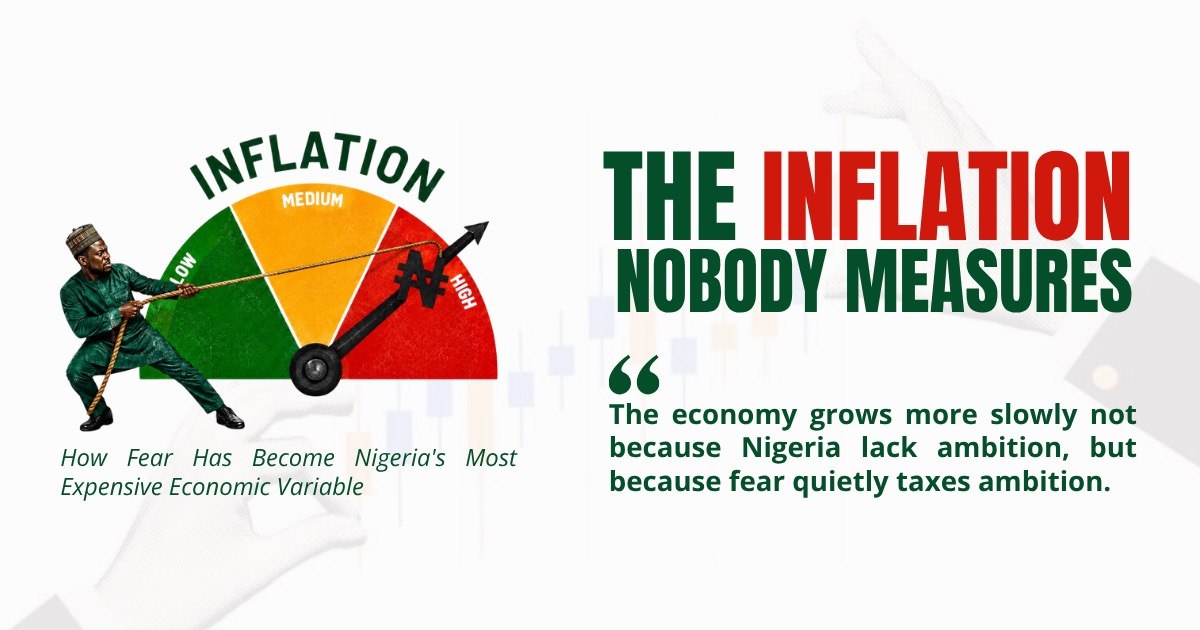

Inflation is one of the few economic forces every Nigerian understands instinctively.
You feel it at the fuel station, in the market, and every time your salary buys a little less than it did the month before. Inflation alters markets and consequently behaviour, families postpone purchases, businesses scale back investments, and governments tighten fiscal policies. Every decision becomes more expensive because money buys less.
There is another form of inflation quietly reshaping Nigeria. It does not appear in reports by the National Bureau of Statistics, and the Central Bank cannot reduce it through monetary policy. Economists rarely include it in macroeconomic forecasts, yet it is altering millions of decisions every day.
It is the inflation of fear.
Like monetary inflation, fear increases costs. Not the cost of food or transportation, but the cost of making decisions. The decision to cultivate farmland. The decision to open a new business. The decision to travel at night. The decision to accept a job in another state. The decision to send a child to boarding school. The decision to invest.The decision to Japa or remain.
Every cost now carries a compounding premium that did not exist before. This is possibly the most overlooked economic consequence of insecurity in contemporary Nigeria.
Every Economy Runs on Confidence
Economists often describe markets through numbers—interest rates, inflation, exchange rates and GDP growth. But beneath these indicators lies something less tangible yet equally important: confidence.
John Maynard Keynes famously referred to this as animal spirits—the confidence that drives households to spend, entrepreneurs to invest and businesses to expand despite uncertainty about the future.
Economies do not grow simply because resources exist, they grow because people believe tomorrow is worth planning for. That confidence is fragile.
When uncertainty becomes persistent, even rational economic actors begin making defensive choices rather than productive decisions.
The consequence is not economic collapse overnight. It is something slower, economic contraction through caution.
Fear Is an Economic Variable
Traditional economics assumes that individuals weigh costs against benefits before making decisions. However, behavioural economics complicates this assumption.
Daniel Kahneman and Amos Tversky demonstrated that people are loss averse. We experience potential losses more intensely than equivalent gains. Losing ₦100,000 hurts considerably more than gaining ₦100,000 satisfies. Under normal circumstances this bias influences everyday choices.
Under conditions of insecurity, it carves up the economic landscape. Imagine a farmer deciding whether to cultivate land several kilometres away. The harvest may promise substantial profit.
Yet, if traveling to the farm carries even a small perceived risk of kidnapping or violent attack, the calculation changes. The expected income remains constant, but the perceived cost rises dramatically. The farmer has not suddenly become less enterprising.
The economics of the decision has changed, fear has inflated the price of taking action.
Multiply that decision by thousands of farmers, traders, transport operators and entrepreneurs across the country, and insecurity begins to look less like a security challenge alone and more like a force quietly reallocating economic activities.
The Hidden Tax on Productivity
Governments impose taxes through legislation, but fear imposes its own without parliamentary approval.
Businesses hire private security where public security is perceived to be inadequate. Manufacturers spend more to insure goods in transit. Transport companies avoid profitable routes considered unsafe.
Hospitals invest in perimeter fencing instead of additional medical equipment. Parents pay higher fees for schools they believe offer greater security.
Each decision is individually rational. Collectively, they represent what economists call transaction costs—the additional costs incurred simply to participate in economic life.
Douglass North, whose work transformed institutional economics, argued that one of the primary purposes of institutions is to reduce uncertainty. Strong institutions lower transaction costs because citizens trust contracts, regulations and public authority.
Weak institutions do the opposite. They make every economic interaction more expensive. Fear, therefore, is not merely an emotional response to insecurity. It is evidence of institutional uncertainty.
Shrinking Horizons
Perhaps, the greatest economic cost of prolonged insecurity is not what it destroys, It is what it discourages.
People begin living within narrower boundaries, students choose universities closer to home rather than those best suited to their ambitions. Investors concentrate projects in locations perceived to be safer. Night-time economies gradually disappear. Communities reduce interaction with neighbouring towns.
Interstate trade weakens, tourism declines, and young professionals reject career opportunities requiring relocation. Development economists have consistently observed that conflict reshapes behaviour long before it destroys infrastructure.
These adaptations are understandable, but they carry profound economic consequences. An economy cannot reach its productive potential when fear continuously rewards caution over innovation.
Governance Is Economic Policy
Conversations about insecurity often focus on military capability. Military responses are essential, but they cannot, on their own, restore economic confidence.
Markets depend on governance, agriculture depends on secure access to land, manufacturing depends on predictable logistics. Investment depends on confidence that contracts will be honoured and institutions will function.
Justice systems influence commercial confidence, procurement systems determine whether security agencies receive the equipment they require. And public communication shapes citizens' confidence during crises.
Security, therefore, is not merely one government sector among many. It is a condition upon which economic activity depends. This is why governance quality consistently predicts long-term development outcomes.
Strong institutions lowers uncertainty, which in turn encourages investment. Investment generates prosperity. This relationship is cumulative, so is its reverse.
Restoring Confidence
Reducing the inflation of fear requires more than military success, it requires institutional credibility.
Citizens invest when they trust that tomorrow will be predictable, businesses expand when they believe regulations will remain stable. Communities cooperate with security agencies when they have confidence that information will be acted upon. Parents send children to school when safety is expected rather than hoped for.
This is where governance becomes inseparable from economic policy. Transparent public procurement strengthens security institutions, responsive policing builds public trust. Accessible justice reduces impunity, and timely public communication limits uncertainty.
Each institutional improvement lowers the hidden premium citizens attach to ordinary decisions, and these reduce the inflation of fear.
Perhaps Nigeria's greatest economic challenge is not simply inflation, unemployment or declining investment. The economy grows more slowly not because Nigerians lack ambition, but because fear quietly taxes ambition itself.
That is why insecurity should not be understood solely through casualty figures or military operations. It should also be understood through economics.
The most expensive consequence of fear is not only the lives it claims, it is the futures it quietly persuades people never to build.